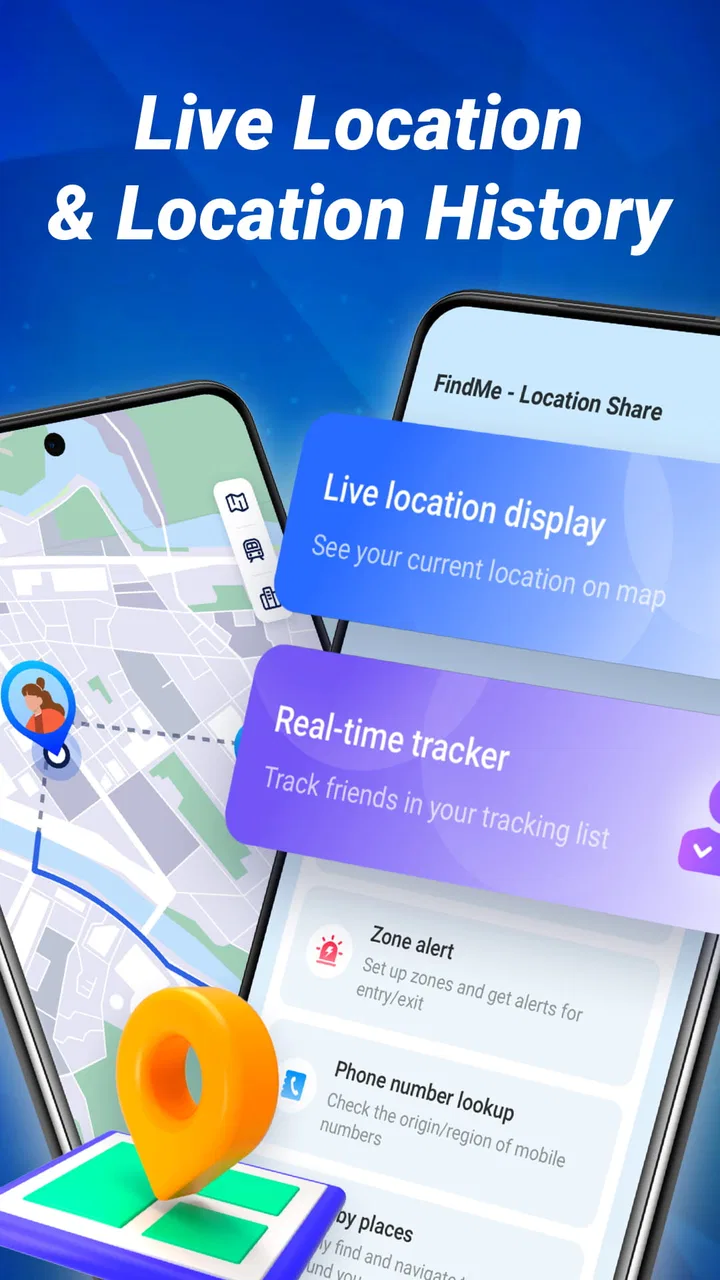
FindMe - Location Share
- 4.2
- Rating
- 1.00M
- Installs
- Free
- Price
 Analysis by App-foxy
I approached FindMe - Location Share as the kind of tool people install with a very practical question in mind: can it make staying connected with family or trusted people easier without becoming another app that demands attention every day? It is a free location-sharing and navigation app from Bersamakitta, aimed at everyone rather than a narrow technical audience. Its purpose is straightforward, but the real test is whether location sharing remains useful after the first week, once the novelty has disappeared.
My first impression is that FindMe fits naturally into the Maps & Navigation category because its value depends less on entertainment and more on timing, reassurance, and routine. A parent may want to know whether a child has reached school, a couple may coordinate a pickup, or friends may keep track of one another during a busy outing. I would not treat it as a replacement for every navigation service on a phone. Instead, I see it as a focused layer for people who need to share whereabouts with people they already trust.
From quick setup appeal to everyday usefulness
The first-week appeal of a family locator is easy to understand. When everyone involved agrees to use it, a shared view of locations can remove a surprising amount of back-and-forth messaging. Instead of asking “Where are you now?” and waiting for a reply, a person can check the shared location when timing matters. That is especially helpful during school runs, airport pickups, errands across town, or a group meeting in an unfamiliar area.
You May Also Like

 Blood Strike: 2.5 Anniversary
Blood Strike’s Loadouts Turn Every Drop Into a Tactical Gamble
A close look at Blood Strike’s custom loadouts: how fast access to signature weapons reshapes its battle royale rhythm, rewards preparation, and narrows the gap between fights.

 Pandora - Music & Podcasts
Pandora’s Music Is Easy to Start, but Harder to Recover
Pandora’s strength is its low-effort path from a seed to a station. Its weak spot is how much confidence it asks you to place in connection, setup, and quiet recovery.

 8 Ball Pool
 Is Built on Rivalries, Rematches, and Routine
A close look at the rivalries, rematches, shared routines, and unanswered safety questions that turn a quick pool match into a persistent mobile community.

 Samsung Music
’s Quiet Strength Is Playing What You Already Own
Its reach comes less from spectacle than from dependable access to a personal library. That simplicity is both the app’s strongest retention engine and its ceiling.

 AccuWeather: Weather Radar
AccuWeather Review: A Quick, Clear Forecast for Everyday Decisions
For everyday plans, the best forecast is the one you can understand quickly. AccuWeather makes rain timing, radar, and local conditions easy to act on, with a few trade-offs.

 Hill Climb Racing
Why Hill Climb Racing Still Turns Crashes Into One More Run
A tiny car, a bumpy hill and one more upgrade: Hill Climb Racing keeps resurfacing because its simple chaos makes every near-miss feel personal.
More From Our News Desk



What makes this type of app different from an ordinary map is the relationship around the map. Standard navigation tools are excellent when I need directions from one place to another, but they are not always designed around a small circle of people who want to coordinate repeatedly. FindMe’s appeal is therefore not just the map itself. It is the possibility of turning location into a shared household or group habit.
I would begin with one limited use case rather than inviting everyone immediately. For example, a family could use it only for the trip home from school or work. That keeps the purpose clear and makes it easier to decide whether the app is genuinely helping. If every person understands when location sharing is expected and when it can be paused, the experience feels more respectful and less intrusive.
A realistic scenario is a parent finishing work while a teenager is traveling home. The parent can use the shared location as a rough coordination aid instead of sending several messages. If the teenager is delayed, the map may provide useful context before anyone starts worrying. It does not remove the need for communication, but it can make communication more timely and less repetitive.
That distinction matters. A location marker is not the same as a conversation, and I would never use FindMe as proof that someone is safe. A phone can be left behind, lose connectivity, or show a position that is not perfectly current. The responsible way to use it is as a convenience for coordination, not as an emergency guarantee.
FindMe is free, which lowers the barrier to trying it with a trusted group. The app carries an Everyone content rating, so its presentation is intended for a broad audience. It was released on May 28, 2025, and the current version is 1.0.30. It also supports devices running Android 7.0 or later, making it accessible to many older Android phones as well as newer models.
Its early reception suggests that people are finding the basic idea useful: FindMe has a 4.2 average from around 1.9 thousand ratings and has passed one million installs. Those figures do not tell me whether it will suit a particular family, but they do show that the concept has reached beyond a tiny group of early adopters. I would still judge it by the quality of the routine it creates, not by popularity alone.
The best way to test it during the first week
My advice is to agree on boundaries before adding people. Decide who should be included, what the sharing is for, and whether everyone is comfortable with the arrangement. This is more important than any map setting because location sharing can quickly feel uncomfortable when expectations are vague. A useful agreement might be that the app helps with travel coordination, but nobody is expected to monitor another person continuously.
I would also test it in ordinary conditions rather than only during an exciting trip. Check it while someone is walking around the neighborhood, commuting, or making a short shopping trip. That reveals whether the app fits real habits. A tool that works only when everyone remembers to open it has a different value from one that supports effortless coordination, and the difference becomes clear quickly.
Another practical test is to compare FindMe with the phone’s existing map and messaging options. If a family already solves every location question with a quick message, FindMe must reduce friction rather than add another step. The advantage should be a shared, repeatable view of whereabouts, not simply another place to send a location pin.
What remains valuable after the novelty fades
Month-to-month value depends on recurring situations. The app earns a lasting place when it helps with a small number of repeated problems: coordinating pickups, checking progress during a journey, finding one another at crowded destinations, or giving a trusted person useful context when plans change. Those are modest benefits, but modest benefits can be worthwhile when they occur every week.
I think FindMe is strongest for households with schedules that regularly overlap but do not line up perfectly. A family may have different school, work, and activity times. A shared location tool can reduce the need for constant updates, particularly when someone is driving or cannot answer immediately. It can also help a group reunite at a festival, shopping center, park, or transit hub where verbal directions are awkward.
There is a less obvious use case for people who dislike phone calls but still need practical coordination. A shared location can communicate progress without requiring a long conversation. That does not mean the app should replace check-ins, especially when plans are uncertain. It simply gives a group another way to understand where a person is in relation to a meeting point.
For travel, the value is situational rather than universal. On a day trip, friends may use shared locations to avoid repeatedly describing landmarks or entrances. In a large public place, seeing where trusted companions are can be more useful than trying to explain a position with street names. However, I would keep the group small and temporary for this purpose. A location-sharing circle that remains active long after a trip can become cluttered and easy to forget.
This is where the app’s long-term design challenge appears. Location sharing is useful because it is persistent enough to save effort, but persistence can also create mental overhead. Every person added to a group creates another relationship to manage. The app is most valuable when the circle reflects a real, current need rather than becoming a permanent list of acquaintances.
Small workflows that make a difference
One useful workflow is to create a clear “arrival check” habit. Before leaving for a pickup, I would look at the shared map to understand whether the other person is still traveling, then use a message only if the timing needs clarification. This avoids turning the app into a screen that gets checked constantly. The map becomes a quick decision tool instead of a source of distraction.
A second workflow is to use it around meeting points rather than monitoring entire journeys. If friends are meeting at a busy venue, knowing their approximate position near the end of the trip can be more useful than watching their route from the beginning. This keeps attention on the practical moment when coordination is difficult and reduces unnecessary checking.
A third insight is that the app works best when paired with explicit exceptions. A person might share location during a commute or group outing but not treat sharing as an all-day obligation. Establishing those exceptions protects trust. It also makes the app more likely to survive beyond the first month because people are less likely to resent a routine that has clear limits.
I would also review the shared group after a major change in routine. Someone may move, change school, stop commuting, or no longer need to participate in a particular activity. Removing outdated members or ending an old sharing arrangement is not a minor administrative task; it is part of keeping the app understandable and comfortable.
The maintenance burden nobody notices at first
The maintenance burden is not necessarily about complicated controls. It is about attention. Every location-sharing app depends on people remembering that access is active, knowing who can see them, and understanding what the map is showing. If those questions are ignored, a convenient tool can gradually become a source of uncertainty.
I would make a short monthly check part of the household routine. Confirm that the right people are still in the group, that the app is being used for the original purpose, and that nobody feels pressured to keep sharing. This is especially important when the app is used by families with children or teenagers, where consent and changing independence deserve more discussion than a simple installation suggests.
Battery and connectivity are practical considerations for any GPS-based tracker, even though the experience can vary by phone and network conditions. I would not assume that a location shown in FindMe is perfectly live at every moment. Before relying on it for a pickup, I would allow extra time and keep another way to contact the person available. That is not a criticism unique to FindMe; it is a basic limitation of phone-based location tools.
There is also a difference between using the app occasionally and depending on it for safety. Occasional coordination is forgiving. Safety-critical use is not. If a family needs specialized emergency response, medical monitoring, or formal workplace tracking, a general location-sharing app is probably not the right category of solution. FindMe makes more sense for everyday awareness between people who already know one another.
Where fatigue can set in
The first source of fatigue is overchecking. Once a map makes someone’s location visible, it can be tempting to open it repeatedly, even when there is no real decision to make. That habit can create anxiety for the viewer and pressure for the person being viewed. I would judge the app successful if it reduces messages and uncertainty, not if it increases the amount of time spent watching a map.
The second source is stale context. A dot on a map may answer “where,” but not “why.” Someone may have stopped for an errand, taken a different route, or left the phone somewhere. Without a simple communication habit alongside the app, users can draw conclusions that the location alone cannot support. I would treat the map as a prompt for a question, not as a complete explanation.
The third source is group sprawl. Adding relatives, friends, coworkers, or neighbors may seem helpful at first, but every additional person makes the sharing arrangement harder to understand. A small group with a clear purpose is easier to maintain than a large network where nobody remembers why access was granted.
There is also a risk of choosing FindMe when a familiar alternative already works better. If I only need to send my position once, a normal messaging app may be faster. If I need turn-by-turn driving directions, a dedicated navigation service may offer a deeper route-planning experience. If I need formal parental controls or emergency features, a specialized family-safety product may be more appropriate. FindMe has a narrower advantage: continuing location sharing among trusted people for everyday coordination.
Privacy expectations can create fatigue as well. Even when everyone agrees initially, feelings can change. A teenager may want more independence, a partner may prefer temporary sharing, or a friend may have joined for one event only. The healthiest use of FindMe includes an easy conversation about stopping or limiting sharing. A tool that supports trust should not be used to avoid trust.
Who should install it, and who should skip it
I would recommend FindMe to families, couples, and small groups that repeatedly coordinate travel and want a shared location view instead of sending individual updates. It is particularly suitable when the same people meet or move around together often. The free price makes experimentation simple, and the broad age rating makes it approachable for mixed-age households.
I would be more cautious about recommending it to someone who wants a complete navigation suite. Its identity is centered on location sharing, not on replacing every map function on a phone. I would also suggest skipping it if the people involved are not comfortable with ongoing location visibility. No convenience is worth creating a monitoring dynamic that damages a relationship.
It may also be a poor fit for users who need guaranteed, highly specialized tracking. A general-purpose app should not be the sole plan for emergencies, vulnerable-person monitoring, or professional fleet management. In those situations, I would look for a service built around the relevant safeguards and operational requirements.
My long-term verdict
After the first-week curiosity wears off, FindMe’s value comes down to discipline and fit. It is not an app I would open for entertainment, and I would not encourage anyone to watch it continuously. Its lasting usefulness is quieter: a shared location can remove a few repeated questions, make pickups smoother, and help trusted people find one another when plans become messy.
The app has a credible foundation as a free Maps & Navigation tool from Bersamakitta, with a current version of 1.0.30 and support for Android 7.0 and later. Its reach of over one million installs shows that the idea is resonating with a substantial audience. Still, the numbers are less important than whether the app fits a group’s communication style.
My recommendation is to use FindMe with a narrow purpose, a small circle, and agreed boundaries. Check it when it helps make a decision, not simply because the map is available. Revisit the sharing arrangement as people’s routines change. With that approach, it can earn lasting space on a phone as a practical family locator rather than becoming another app that creates more checking than value.
FindMe - Location Share is worth trying if your everyday problem is shared whereabouts among trusted people. It is not the right answer for every navigation or safety need, but for recurring coordination, its simplicity can be useful. The real test is whether it quietly saves effort month after month. If it does, keeping it installed makes sense; if it only adds another layer of supervision or screen time, a simpler alternative may serve you better.
FAQs for FindMe - Location Share
01What is FindMe - Location Share and how does it work?
FindMe - Location Share is an app designed for sharing your real-time location with friends and family. It uses GPS technology to provide accurate location data. Users can send location updates through secure links, allowing others to track their movements on a map for a specified period. It's perfect for meeting up or ensuring safety during travel.
02Is FindMe - Location Share safe to use?
Yes, FindMe - Location Share prioritizes user safety by offering encrypted connections and privacy controls. You can choose who receives your location and for how long. The app ensures that only people you authorize can view your location, and you can stop sharing at any time to maintain privacy.
03Can FindMe - Location Share drain my phone's battery quickly?
While using GPS can impact battery life, FindMe - Location Share is optimized to minimize battery usage. The app efficiently manages location updates to balance accuracy with power consumption. For prolonged use, consider reducing update frequency or utilizing battery-saving modes available in the app settings.
04Are there any costs associated with using FindMe - Location Share?
FindMe - Location Share is available as a free download with basic features. However, it may offer in-app purchases or subscription plans for advanced features like extended tracking history or additional privacy options. Check the app store for detailed pricing information and options that suit your needs.
05What platforms is FindMe - Location Share available on?
FindMe - Location Share is available on both Android and iOS platforms, ensuring compatibility with a wide range of smartphones. The app supports the latest operating systems, providing seamless integration and updates to improve functionality and user experience. Check your device’s app store for availability.
Pros
- Easy-to-use interface for all ages.
- Real-time location tracking is accurate.
- Battery consumption is minimal.
- Supports group location sharing.
- Integration with maps for navigation.
Cons
- Requires constant internet connection.
- Limited features in free version.
- Privacy concerns with data sharing.
- Notifications can be intrusive.
- In-app ads in free version.

FindMe - Location Share
Gallery